PROBLEM
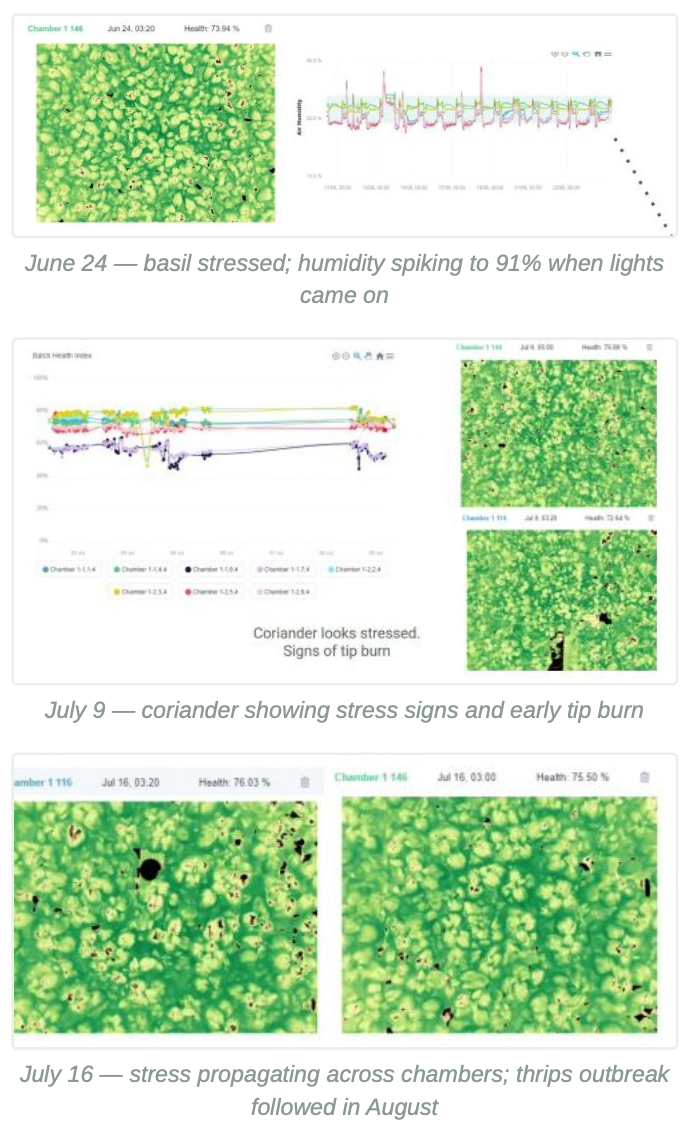
Thrips outbreaks rarely arrive without warning — they're the consequence of weeks of accumulated stress that goes unnoticed in real time. This farm had repeated humidity spikes (91–92% when lights came on) and stress signatures across basil and coriander throughout June and July. When staff went on holiday in August, the population exploded and took over.
ECOSENSE INTERVENTION
- Detected the humidity spike events on June 24 and the stress signatures in basil (June 24) and coriander (July 9–16) as they happened.
- Continuously logged the leading indicators — the patterns that precedea thrips outbreak by weeks.
- Built a record of the chain of stressors that allowed the outbreak to be reconstructed and prevented next time.
RESULTS
- The pattern of conditions that precedes a thrips outbreak is now identifiable in advance — not in retrospect.
- Future outbreaks of this type can be intercepted before population growth becomes uncontrollable.
- The underlying causality of pest outbreaks shifted from invisible to documented.