By robynecobloom 2026-05-04
Ecobloom presents in NASA’s lunch and learn
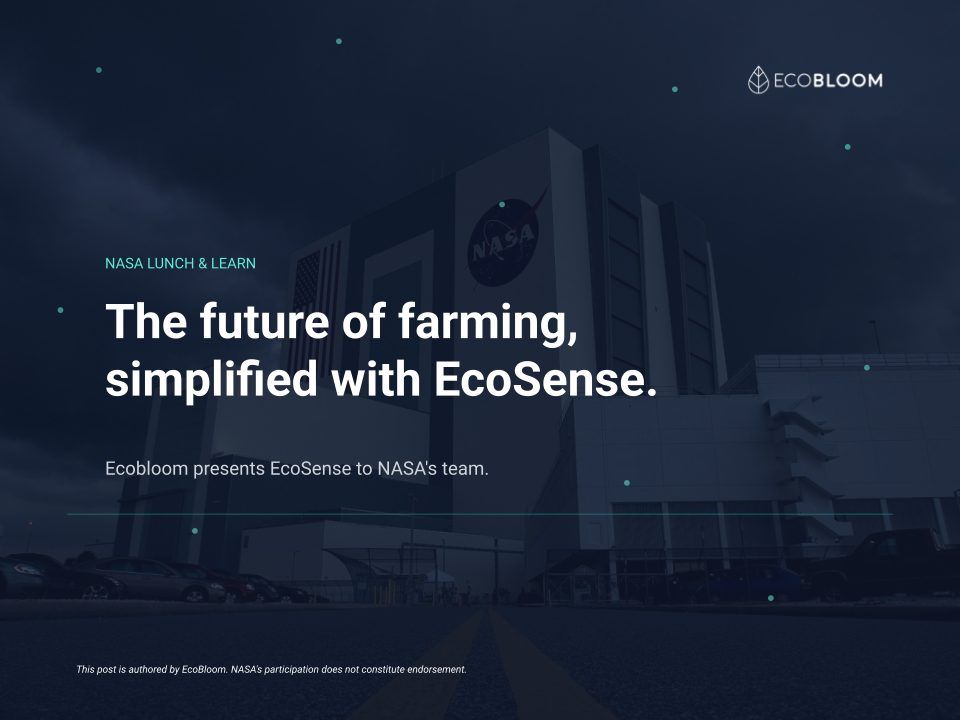
Indoor farming is no longer a niche experiment it is a rapidly scaling industry facing real operational complexity. Controlling light, humidity, CO₂, nutrient delivery, and plant health across hundreds of growing rows simultaneously is a data problem as much as an agricultural one. That’s the problem EcoSense was built to solve. And recently, we had the opportunity to present our work to a room that thinks about these challenges from a very different angle: NASA’s Advanced Plant Imaging team.
The Event: NASA’s Lunch & Learn
NASA’s Lunch & Learn is a recurring internal technical seminar, the kind of forum where university researchers, engineers, and industry innovators share work that sits at the frontier of applied science. The sessions are built around scientific rigour: data, methodology, and outcomes. Presentations typically run 40 to 45 minutes, followed by open discussion with a technically varied but sharp audience.
Being invited to present in that format is meaningful to us. It reflects where EcoSense sits: not as a consumer tool, but as a technically grounded platform built on real plant science and sensor engineering. Our presentation covered the science behind EcoSense, how our multispectral imaging approach works, and what the platform enables for growers operating in controlled environments today.
The Science Behind the Platform
EcoSense was developed at the intersection of precision agriculture, engineering, and applied machine learning. The multispectral camera nodes are engineered for the specific light environments and spatial requirements of indoor growing facilities.
The AI models underpinning EcoSense are trained on crop-specific physiological data. This means the platform understands what healthy iceberg lettuce looks like at day 14 versus day 21 of a growth cycle and what deviations from that baseline indicate. Disease probability scoring, nutrient deficiency flags, and maturity index tracking are outputs grounded in agronomy, not generic anomaly detection.
Presenting this work in a NASA context alongside researchers working on advanced plant imaging was a valuable scientific exchange. The questions raised in that room reflect the rigour we hold ourselves to in our own development process.
Looking Ahead
Presenting EcoSense at a forum like this is part of a broader commitment: to build technology, not just commercial evaluation. The indoor farming industry is young, but the technical bar is rising quickly and we intend to be at the front of it.
Note: This post is authored by EcoBloom. NASA’s participation as a host in their Lunch & Learn program does not constitute endorsement of EcoBloom or EcoSense.
Share post: